Nano vs Micro Influencers: Complete Comparison for 2026
 Mohit Kumar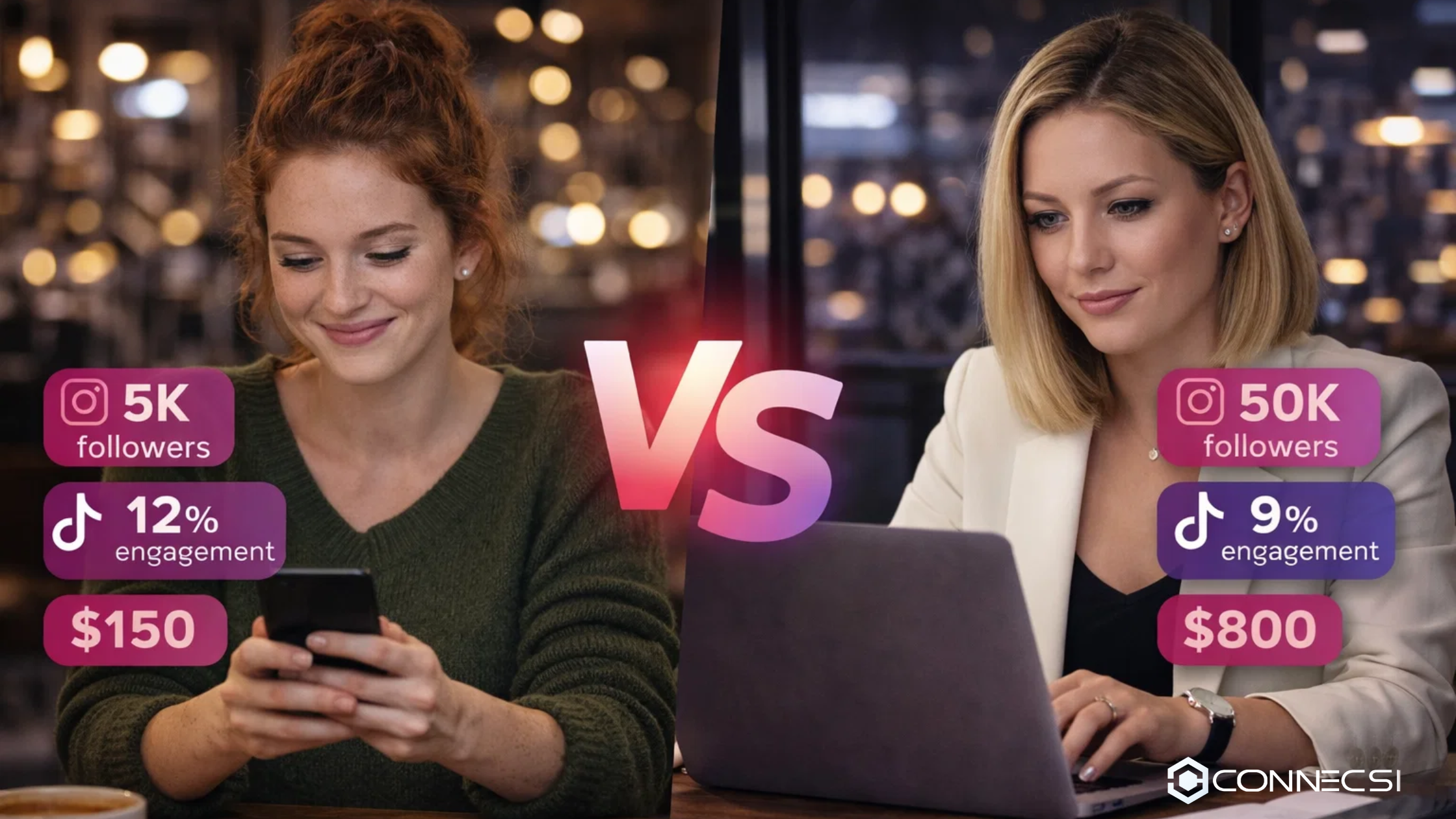
Choosing between nano influencers (1,000-10,000 followers) and micro influencers (10,000-100,000 followers) represents one of the most critical decisions brands face when building influencer marketing strategies on limited budgets. Both creator tiers deliver exceptional engagement rates compared to macro influencers, both offer cost-effective alternatives to celebrity partnerships, and both provide authentic community connections that drive real business results. Yet the differences between nano and micro influencers—in pricing, reach, professionalism, and campaign scalability—determine which tier best aligns with specific marketing objectives.
According to Oberlo's creator tier analysis, nano influencers average 10-15% engagement rates while micro influencers deliver 8-10%—both dramatically outperforming macro influencers' 2-4%. Meanwhile, nano partnerships typically cost $0-$250 compared to micro influencers' $200-$2,000 range. Understanding when each tier excels requires examining audience quality, content professionalism, partnership logistics, and optimal applications.
💡 PRO TIP: The nano versus micro decision isn't either/or for most brands. The most sophisticated approach uses nano influencers for hyper-local campaigns and authentic product seeding while leveraging micro influencers for broader market reach and more polished content. Think of nano creators as grassroots advocates and micro creators as professional content partners—both serving distinct strategic purposes.
Engagement Rate and Reach Comparison
Engagement rate differences between nano and micro influencers reveal fundamental distinctions in audience relationships and content consumption patterns. Research from Later's engagement research shows nano influencers consistently achieving 10-15% engagement rates on Instagram, with top performers reaching 15-20%. Micro influencers average 8-10% engagement, with exceptional creators hitting 10-12%.
The 2-5 percentage point difference compounds significantly at scale. A nano influencer with 5,000 followers at 12% engagement generates approximately 600 interactions per post. A micro influencer with 50,000 followers at 9% engagement generates 4,500 interactions—7.5x more absolute engagement from 10x more followers. The micro creator delivers more total reach and engagement, but the nano creator's engagement-per-follower efficiency is higher.
Why do nano influencers maintain higher engagement rates? Personal relationships play a larger role—many nano followers know the creator personally or semi-personally, creating social obligation to engage. Reciprocal engagement is more feasible; nano creators can respond to every comment and engage with followers' content. Audience homogeneity means nearly all followers care deeply about the creator's niche, while micro audiences become more diverse as follower counts grow.
| Metric | Nano (1K-10K) | Micro (10K-100K) |
|---|---|---|
| Instagram Engagement | 10-15% | 8-10% |
| TikTok Engagement | 11-13% | 9-11% |
| Typical Cost Per Post | $0-$250 | $200-$2,000 |
| Post Interactions | 500-1,500 | 2,000-10,000 |
| Follower Recognition | Often Personal | Community-Based |
Cost Comparison and Budget Implications
Pricing differences between nano and micro influencers create dramatically different campaign possibilities. According to Shopify's influencer pricing data, 47% of nano influencer partnerships cost under $250, with 31% accepting only product gifting. Nano creators with 1,000-5,000 followers often work for free products valued at $50-$100, while those with 5,000-10,000 followers typically charge $100-$500 per post.
Micro influencers operate with more standardized pricing. Creators with 10,000-50,000 followers charge $200-$800 per Instagram post, $150-$600 per TikTok video, and $500-$1,500 for YouTube integrations. Those with 50,000-100,000 followers command $800-$2,000 per Instagram post.
A $5,000 budget funds partnerships with 20-50 nano influencers through product gifting and small payments, creating distributed authentic advocacy across multiple geographic markets. The same budget funds 3-8 micro influencer partnerships, delivering more polished content, larger individual reach, and professional content that can be repurposed in paid advertising.
Cost-per-engagement calculations reveal efficiency nuances. If a nano partnership costs $150 and generates 600 engagements, the cost per engagement is $0.25. A micro partnership costing $800 and generating 4,000 engagements costs $0.20 per engagement—more efficient despite higher upfront cost. However, nano's lower entry price makes testing more accessible.
Understanding micro influencer pricing structures helps contextualize these cost differences and budget accordingly.
Audience Quality and Content Professionalism
Nano influencer audiences tend toward extreme homogeneity. A nano creator focused on "sustainable fashion for working moms in Seattle" attracts followers who care deeply about that exact intersection. Geographic concentration is common—60-80% of nano followers often live in the same city or region. This creates laser-focused targeting but limits total addressable reach.
Micro influencer audiences maintain niche focus while expanding geographic and demographic diversity. A sustainable fashion micro influencer attracts followers nationwide, spanning broader age ranges while maintaining category interest. This provides larger reach within a niche but potentially lower conversion rates as audience precision decreases.
Content quality also differs meaningfully. Nano influencers typically create content on smartphones with minimal editing using free apps. Their content aesthetic is authentic and relatable but rarely polished to professional standards. This authenticity resonates with audiences seeking genuine recommendations over glossy advertising.
Micro influencers often invest in better equipment—dedicated cameras, ring lights, editing software subscriptions. Many have developed signature visual styles and professional-quality output. Their content works both for organic posting and brand repurposing in paid advertising or website hero images.
When to Choose Nano Influencers
Nano influencers excel in specific scenarios where their unique advantages align perfectly with campaign objectives.
Hyper-local campaigns benefit enormously from nano creators' geographic concentration. A restaurant chain opening in 5 new cities can partner with 3-5 local nano food bloggers per market, creating authentic neighborhood buzz that drives foot traffic.
Limited budgets under $2,000 make nano partnerships the only viable option. Brands can execute meaningful campaigns with 10-20 nano creators through product gifting and small payments, building social proof that punches above budget weight.
Authentic product testing and feedback works better with nano creators who maintain editorial independence. Because they don't depend on influencer income, they provide honest feedback and only post about products they genuinely love.
Community-based brands serving specific demographics, identities, or values connect authentically through nano influencers who are actual community members. A disability-focused brand partnering with disabled nano creators achieves authenticity macro creators cannot replicate.
When to Choose Micro Influencers
Micro influencers become the better choice when specific campaign requirements align with their unique advantages.
Broader market reach within niches needs micro influencers' larger audiences. An e-commerce brand selling nationwide wants creators reaching customers across states, not concentrated in single cities. Micro creators provide geographic distribution while maintaining niche focus.
Professional content for repurposing justifies micro partnerships when brands plan to use creator content in paid advertising, website hero images, or email campaigns. Micro creators' production quality and rights negotiation experience make repurposing straightforward.
Budgets exceeding $5,000 enable working with enough micro creators to achieve meaningful scale. At this budget level, managing 5-10 micro partnerships delivers better results than coordinating 30-40 nano creators due to reduced management complexity.
Time-sensitive campaigns with tight deadlines require micro influencers' professional responsiveness and reliability. Nano creators' variable timelines and part-time availability create risk for campaigns with launch dates or seasonal windows.
For strategic context on influencer tier decisions, review our comprehensive analysis comparing micro and macro influencers.
The Hybrid Approach: Using Both Strategically
The most sophisticated influencer strategies don't choose exclusively between nano and micro—they use both tiers for complementary purposes. A typical hybrid architecture dedicates 60-70% of influencer budget to micro creators for consistent content production, reliable reach, and professional partnerships. The remaining 30-40% funds nano creator networks for grassroots advocacy, local market penetration, and authentic product seeding.
Product launch campaigns exemplify hybrid strategy. Pre-launch, seed products to 20-30 nano creators who provide authentic early feedback and user-generated content. At launch, activate 5-10 micro creators for polished announcement content reaching broader audiences. Post-launch, maintain nano relationships for ongoing organic mentions while cycling micro partnerships to sustain visibility.
Geographic hybrid strategies work well too. National brands can partner with micro creators for nationwide reach while using nano creators for local activation in key markets—3-5 nano creators per city in top 10 metro areas creating local relevance that macro awareness can't achieve.
- Nano influencers deliver 10-15% engagement versus micro's 8-10%, providing higher per-follower efficiency but lower total reach—nano excels for hyper-targeted local campaigns while micro serves broader market needs
- Nano partnerships cost $0-$250 versus micro's $200-$2,000, enabling 20-50 nano collaborations or 3-8 micro partnerships on a $5,000 budget—each approach serves different strategic purposes
- Choose nano for hyper-local campaigns, budgets under $2,000, authentic product testing, community-based brands, and test marketing before larger investments
- Choose micro for broader geographic reach, professional content repurposing, budgets exceeding $5,000, time-sensitive campaigns requiring reliability, and long-term ambassador programs
- Hybrid strategies allocate 60-70% of budget to micro creators for consistent reach and 30-40% to nano networks for grassroots advocacy and local market penetration
- Nano creators offer extreme audience homogeneity and personal relationships but require more management bandwidth; micro creators provide professional reliability and polished content but less intimate follower connections
Conclusion
The nano versus micro influencer decision depends entirely on campaign objectives, budget constraints, geographic requirements, and content needs. Nano influencers excel when intimate community connections, hyper-local targeting, or minimal budgets drive strategy. Micro influencers shine when broader reach, professional content, or reliable execution matter most.
For most brands, the answer isn't choosing one tier exclusively but strategically combining both. Nano creators provide grassroots authenticity and local market depth that no amount of reach from larger creators can replicate. Micro creators deliver professional content and reliable scale that nano partnerships struggle to match. Used together, they create comprehensive influencer programs that capture both intimate community advocacy and broader market presence.
The brands thriving with influencer marketing in 2026 understand these nuances. They match creator tiers to specific campaign objectives, use nano for authentic seeding and local activation, leverage micro for content production and reach, and measure both tiers against appropriate KPIs recognizing each serves different strategic purposes.
Ready to build strategic influencer programs leveraging both nano and micro creators effectively? Connecsi helps you discover, vet, and manage creator partnerships across all tiers—from nano to mega—with data-driven insights that match creator capabilities to campaign objectives for maximum ROI.
More insights for you.

What Your Favorite Creators Actually Earn: Inside the Highest Paid Creators of 2026
MrBeast made $300M. Another creator made $31M from just 10 million followers. Here's what the top 10 actually sell, and the do's and don'ts to borrow.

Your UGC Portfolio: You Need 5 Videos Before Any Brand Will Pay You
Most new creators pitch with nothing attached and blame a saturated market. Five sample videos changes every conversation. Here's exactly what to shoot.

Influencer Marketing Attribution: Why You Still Can't Prove What Worked
Your finance lead asks which sales came from creators. Most brands can't answer. Here's why the tracking breaks, and the stack that actually holds up.
Fresh insights.
Straight to your inbox.
- Creator partnerships
- Campaign guidance
- Industry insights