Brands That Turned Influencer Marketing Into Real Sales (Without Needing a Billion-Dollar Following)
 Mohit Kumar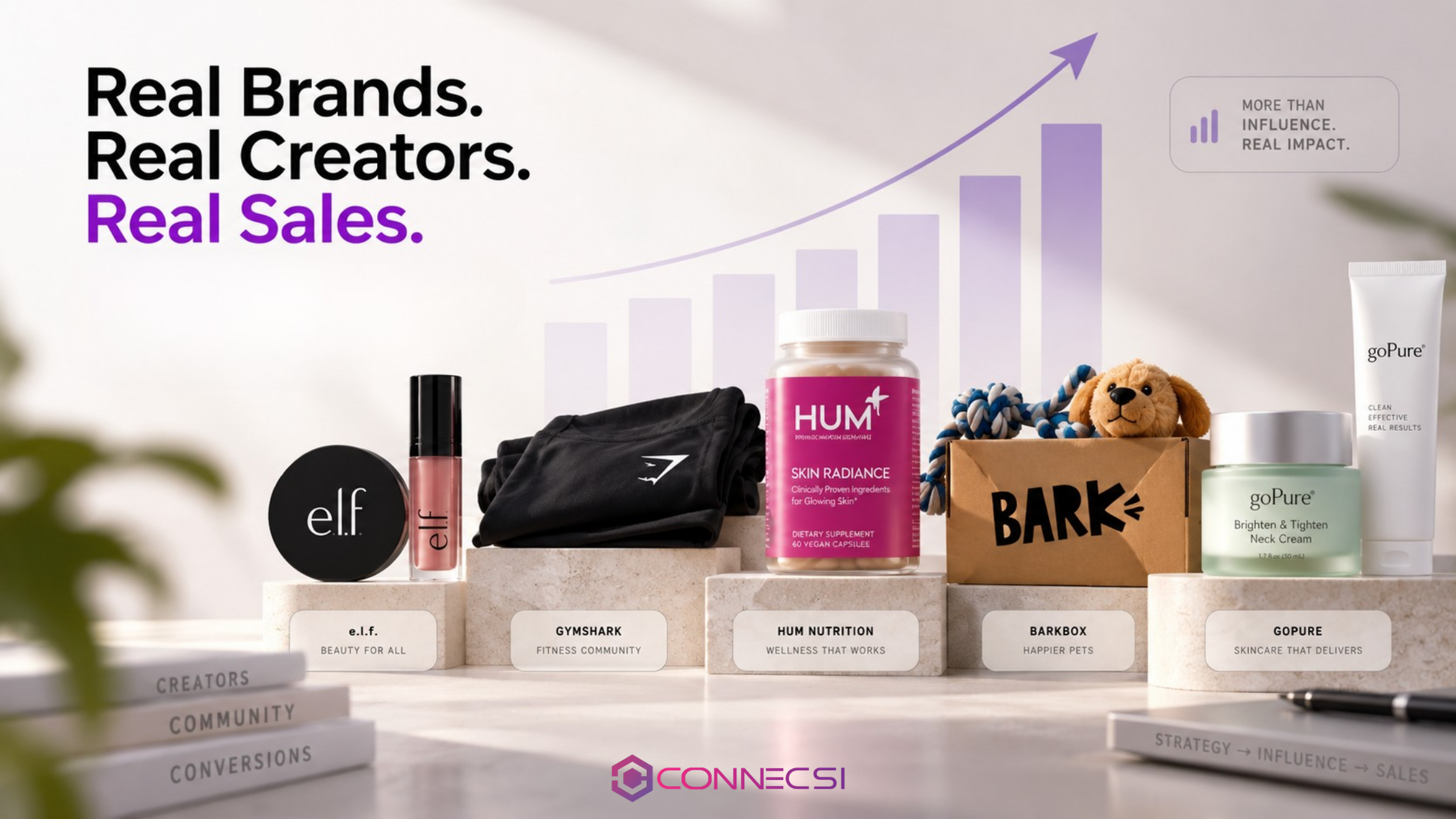
On this page
- Introduction
- Pro Tip
- 1. e.l.f. Cosmetics — How a Legacy Brand Reignited Growth With a Tiered Creator Strategy
- 2. Gymshark — Built From a Garage With Nothing but Free Product
- 3. HUM Nutrition — 940% Follower Growth From 50 Micro-Influencers
- 4. BarkBox — Creator Content Beat Studio Production Head-to-Head
- 5. goPure — $200K in Revenue From Product Seeding Alone
- What All Five Have in Common
- Key Takeaways
- The Bottom Line
Logan Paul and KSI's Prime Hydration proved that creator trust can build a billion-dollar brand almost overnight — and, just as importantly, that fame alone doesn't sustain one. But Prime's story leaves an obvious question unanswered: what does this actually look like for a brand that isn't backed by two of the most-followed creators on the internet?
The answer is that the same underlying mechanism — creator trust converting into sales faster and cheaper than paid advertising — shows up constantly at every scale, if you know where to look. Here are five real brands that used it deliberately, with real numbers behind the results, spanning beauty, fitness, and pet products. Two are companies you'll recognize. Three are proof that you don't need to be one.
Notice what's missing from every case study below: a single celebrity moment. Every one of these results came from a tiered mix of creators and a deliberate strategy, not a lucky viral hit.
1. e.l.f. Cosmetics — How a Legacy Brand Reignited Growth With a Tiered Creator Strategy
e.l.f. Cosmetics wasn't a startup betting everything on influencer marketing — it was an established beauty brand that had seen sales decline before rebuilding its growth almost entirely around creator content. Its #eyeslipsface campaign, built around an original song and creators across every follower tier, generated nearly 5 million user-submitted videos and roughly 7 billion views. A 2023 lip-kit collaboration with beauty creator Mikayla Nogueira sold out in 18 minutes; when it restocked in 2024, it sold out again in 10 hours, generating over 19 million TikTok views at a 9.3% engagement rate.
The strategic detail worth stealing: e.l.f. runs a genuinely tiered creator program, from nano creators for authenticity to major names for concentrated launch reach — and when the brand increased its marketing investment from 7% to 25% of net sales, largely into creator-led content, it drove 77% year-over-year revenue growth. A separate paid-acquisition push with TikTok reduced its cost per add-to-cart by 56%. This is a brand with every resource to run traditional advertising, choosing to build its growth engine around creators instead.
What a smaller brand can actually take from this isn't the billion-view campaign — it's the tiering structure underneath it. e.l.f. didn't rely on one creator tier to do everything; nano and micro creators built the authenticity and volume, while a smaller number of larger names created concentrated moments around specific launches. That same structure works at a tenth of the budget, just with smaller numbers attached.
2. Gymshark — Built From a Garage With Nothing but Free Product
Before it was a fitness apparel company valued above £1 billion, Gymshark was 19-year-old Ben Francis running a screen-printing operation out of his parents' garage, unable to afford any advertising at all. His entire early strategy was sending free gym gear to fitness YouTubers whose audiences matched who he wanted to reach — the same product-gifting model that costs a small brand almost nothing but inventory today.
That seeding strategy evolved into a formalized three-tier structure — seeding, then ambassador, then a top "Gymshark Athlete" tier — built over roughly seven years, not overnight. Revenue grew from around £1 million in 2013 to £258 million by 2020, the year General Atlantic invested at a valuation over £1 billion, making Gymshark only the second British company since 2001 to reach that milestone without prior external funding. The lesson isn't the billion-pound endpoint. It's that the entire engine started with a founder who couldn't afford ads, and used product gifting and patient, tiered relationship-building instead.
Gymshark's real advantage over a Prime-style celebrity launch was time. Because the strategy started with near-zero cost, there was no pressure to prove it worked instantly — creators who consistently drove engagement graduated into ambassadors, and ambassadors who kept performing became the highest tier. Nothing was promised upfront that hadn't already been earned.
3. HUM Nutrition — 940% Follower Growth From 50 Micro-Influencers
HUM Nutrition, a wellness supplement brand, didn't chase a single mega-name. It partnered with 50 micro-influencers whose personal brands and audiences aligned closely with HUM's own — a roster that was roughly 97% women, matching the brand's core demographic. In 14 months, HUM's Instagram following grew from 25,000 to 240,000 — a 940% increase — and the campaign secured over 65 fully licensed content assets the brand could reuse across its own marketing.
That last detail matters as much as the follower growth. A well-run micro-influencer campaign doesn't just drive an immediate spike — it builds a content library a brand keeps using long after the campaign ends, something paid advertising never leaves behind once the spend stops. HUM's approach also shows why audience alignment beats raw reach: a roster chosen specifically for matching HUM's own demographic converted better than a larger, less targeted following would have.
4. BarkBox — Creator Content Beat Studio Production Head-to-Head
BarkBox ran a direct, controlled comparison most brands never get to see: the same paid Meta ad campaigns, running creator-generated content against studio-produced creative. The creator content drove 13% more subscription conversions at a 13% lower cost per acquisition than the polished, professionally shot version. Separately, the brand's "Indestructible Challenge" creator campaign passed 10 million views.
The mechanism behind this result shows up across the pet category specifically: authentic footage of a real animal engaging with a product consistently outperforms polished advertising in a social feed, because it doesn't trigger the instinctive ad-blindness a viewer develops toward anything that looks like a commercial. For pet brands in particular, this is measurable evidence that creator content isn't just cheaper than studio production — in a head-to-head test, it converted better.
The broader lesson applies well beyond pet products. Any brand running paid social can replicate BarkBox's test: run the same budget against creator-sourced content and studio-produced creative simultaneously, and let the actual conversion data — not internal opinions about which looks more "on-brand" — decide which one gets the larger share of future spend.
5. goPure — $200K in Revenue From Product Seeding Alone
goPure is the clearest proof that this playbook doesn't require a marketing budget at all, let alone a celebrity one. The skincare brand recruited more than 160 micro-influencers purely through product seeding and gifting — no cash spend beyond the product itself. In two months, those creators generated 147 video reviews, and the resulting campaign drove a reported 26% conversion rate and more than $200,000 in attributed revenue.
One honest caveat: this case study comes from Insense, the platform that ran the campaign, so treat the specific ROI figure as a vendor's own claim rather than independently audited data. But the underlying mechanics — a genuinely small brand, zero cash spend, gifting at volume to a wide bench of micro-influencers — are exactly the gifting tier of a tiered strategy in action, and a realistic starting point for a brand with no advertising budget at all.
What makes this the most replicable case study on this list is the absence of anything a small brand doesn't already have. No celebrity relationship, no seven-figure ad budget, no proprietary manufacturing partnership — just product, a willingness to send it to enough creators, and the patience to let volume do the work that a single expensive placement can't.
What All Five Have in Common
None of these results came from a single viral moment or one expensive creator relationship. Every brand here used a deliberate mix of creator tiers, matched the deal structure to the risk — gifting for the widest, cheapest reach; commission or ambassador status only once a creator proved themselves — and measured results in actual sales or conversions, not just follower counts or vanity impressions. That's the same structure behind Prime and Feastables, just without the celebrity price tag attached to it.
It's also worth noticing what's absent from every one of these stories: a big upfront bet on an unproven relationship. e.l.f. and Gymshark both built their creator programs over years, not weeks. HUM and goPure both started with the lowest-risk deal type — micro-influencer outreach and product gifting — before any larger spend followed. BarkBox only knows creator content outperforms studio production because it tested the two head-to-head instead of assuming. That pattern of testing before committing is the actual throughline connecting a garage startup to a billion-dollar apparel brand.
- e.l.f. Cosmetics drove 77% year-over-year revenue growth by shifting spend toward a tiered creator strategy, and cut acquisition costs by 56% with creator-led TikTok ads.
- Gymshark started as free product seeding to fitness YouTubers from a founder's garage — the same gifting model any small brand can use today.
- HUM Nutrition grew its Instagram following 940% in 14 months using 50 micro-influencers, while building a reusable content library.
- BarkBox's creator-generated content beat studio-produced ads head-to-head: 13% more conversions at 13% lower cost.
- goPure generated over $200,000 in revenue from 160+ micro-influencers using product gifting alone — zero cash marketing spend.
- Every case study shares the same structure: a tiered creator mix, deal types matched to risk, and results measured in real sales, not vanity metrics.
The Bottom Line
These five brands prove the same thing Prime and Feastables do, just without the celebrity founders: creator trust converts, and it converts at every budget level, not just the ones with a household name attached. What separates the brands that see real results from the ones that don't isn't luck or follower count — it's a deliberate, tiered strategy and deal structures that match the risk of each partnership.
Notice, too, how differently these five stories end compared to Prime's. Every brand here is still growing — because none of them bet everything on a single moment of hype. That's the quiet advantage of building this way: it's slower to make headlines, but far harder to lose everything you've built once the initial excitement fades.
That's exactly the strategy our team builds for brands, using years of hands-on experience and the same tiered, risk-calibrated approach behind every case study above. Talk to us about building your own version of this playbook.
Editorial note: Brand names, logos and trademarks referenced in this article belong to their respective owners. Connecsi is not affiliated with or endorsed by the brands, creators or individuals discussed unless explicitly stated otherwise. References are made for editorial, educational, analytical and commentary purposes.
Featured image is an original editorial illustration created for Connecsi.
More insights for you.
What Your Favorite Creators Actually Earn: Inside the Highest Paid Creators of 2026
MrBeast made $300M. Another creator made $31M from just 10 million followers. Here's what the top 10 actually sell, and the do's and don'ts to borrow.

Your UGC Portfolio: You Need 5 Videos Before Any Brand Will Pay You
Most new creators pitch with nothing attached and blame a saturated market. Five sample videos changes every conversation. Here's exactly what to shoot.

Influencer Marketing Attribution: Why You Still Can't Prove What Worked
Your finance lead asks which sales came from creators. Most brands can't answer. Here's why the tracking breaks, and the stack that actually holds up.
Fresh insights.
Straight to your inbox.
- Creator partnerships
- Campaign guidance
- Industry insights